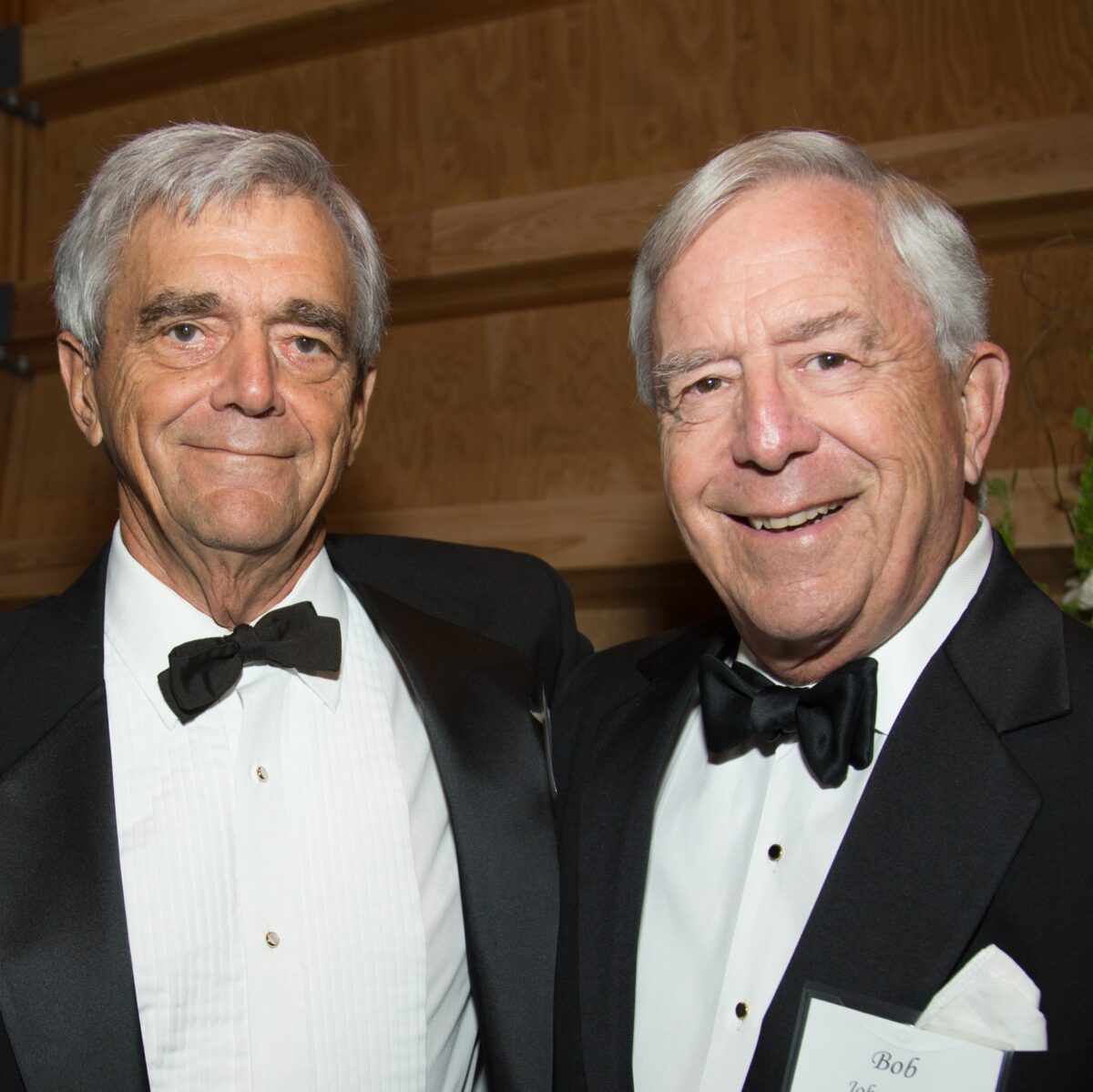
Mystic Seaport honored Bob and Rod Johnstone – J/Boats with the 2016 America and the Sea Award. Presented annually by the Museum, the prestigious award recognizes an individual or organization whose contribution to the history, arts, business, or sciences of the sea best exemplify the American character.
The Johnstones received the award October 22 at a gala dinner held in their honor at the Museum. The gala will be the first and only dinner held in the Collins Gallery in the new Thompson Exhibition Building prior to its present use to display exhibitions.
“Over the past 39 years, the Johnstone family and their company have influenced American yachting and sport of sailing in incomparable ways. They have established a record of accomplishment that few will ever challenge, and they have instilled in countless Americans a passion for enjoying time on the water with family and good friends aboard good boats,” said Steve White, president of Mystic Seaport. “For these reasons and many more, Mystic Seaport was proud to bestow its America and the Sea Award to Bob and Rod Johnstone – J/Boats.”
 The J/Boats story began in 1974 when Rod, then an ad salesman for Soundings Magazine, designed and started building the 24-foot sailboat Ragtime in his Stonington, CT garage. Launched in the Spring of 1976, it beat everything in sight.
Bob, then vice president of marketing at AMF Alcort, saw the potential in Rod’s design and a 50/50 partnership was formed in February 1977 to build and market the J/24. Today, some 14,000 “J’s” in 40 different designs are sailing in more than 35 countries. “J” owners have won silver in major sailing events worldwide including Fastnet, SORC, Transpac, Pacific Cup, Swiftsure, Ensenada, Middle Sea, Sydney-Hobart, OSTAR, Chicago-Mac, and the Bermuda Race. The J/24 was named “Best Keelboat in 30 years” by SAIL Magazine in 1981. A decade later, the J/105 revolutionized keelboat design with its retractable bowsprit and asymmetrical spinnaker. Nineteen other “J” designs have earned Boat-of-the-Year or Hall of Fame recognition. Five designs have achieved World Sailing’s International Class status. J/Boats Inc. was named by Fortune in 1991 as one of America’s Best 100 Products. J/Boats in the USA are built in Rhode Island and by licensed builders in France, Italy, South Africa, Argentina, and China. J/Boats remains a family business.
 Bob and Rod grew up racing LI One-Designs and Lightnings at the Wadawanuck YC in Stonington CT, where from 1947 to 1954 they took home many club and ECYRA trophies. With their father, Rob, they built Lightning #3310 in a suburban Glen Ridge, NJ, garage, setting them on a course of sailing for life.
After Princeton (’56), Bob spent 17 years managing Quaker Oats subsidiaries in Colombia and Venezuela. Returning to Chicago, he became Quaker’s Marketing Man of the Year. Later at AMF Alcort, he acquired marine market experience, a key to start-up success of J/Boats. In 2002, with the next generation in place at J/Boats, he founded MJM Yachts. The MJM 50z received the 2014 AIM Editors Award for Best Down East Cruiser 50 Feet Plus. Bob has won the 1969 Penguin Internationals, National Hospice Regatta, Maine Retired Skippers Race, New York Yacht Club Queen’s Cup plus Antigua, Block Island, Charleston, Key West and Down East Race Weeks. He was runner-up in the 1983 J/24 Worlds, served as Secretary/Treasurer of the United States Olympic Sailing Committee and was founding chairman of both the United States Youth Sailing Championship and J/24 Class Association. Bob and his wife, The Reverend Mary Johnstone, reside in Newport RI. He is a member and Past Commodore of the Northeast Harbor Fleet and a member of the New York Yacht Club and Little Cranberry Island Yacht Club.
 After Princeton (’58) Rod started designing and building sailboats while teaching history at the Millbrook School in NY from 1959 to 1962. He then ran a yacht brokerage in Stonington, later becoming a planner for submarine builder Electric Boat Co. Rod sold ads for Soundings from 1970 to 1977 when he came to know the key players in the sailboat industry, especially Everett Pearson, whose role as builder of J Boats designs for over 25 years was key to their success. In 1988 Rod co-founded Johnstone Yachts, Inc. with nephew Clay Burkhalter to produce his JY 15 sailboat design. Nephew-in-law, David Eck, took over in 1991 and produced over 3,300 JY 15s. Mystic Seaport uses JY 15s in its sail training program. Rod still helps design new J/ Boats and continues to race actively. He has won championships in the J/24, J/22, J/30, J/35, J/120, J/70 and J/88 classes and at various Race Weeks. Rod and his wife, Lucia, live in Stonington. He is a member and Past Commodore of the Wadawanuck Yacht Club, a member of the Stonington Harbor Yacht Club, Past Chairman of the Stonington Board of Education, and member of the Stonington Harbor Management Commission.